
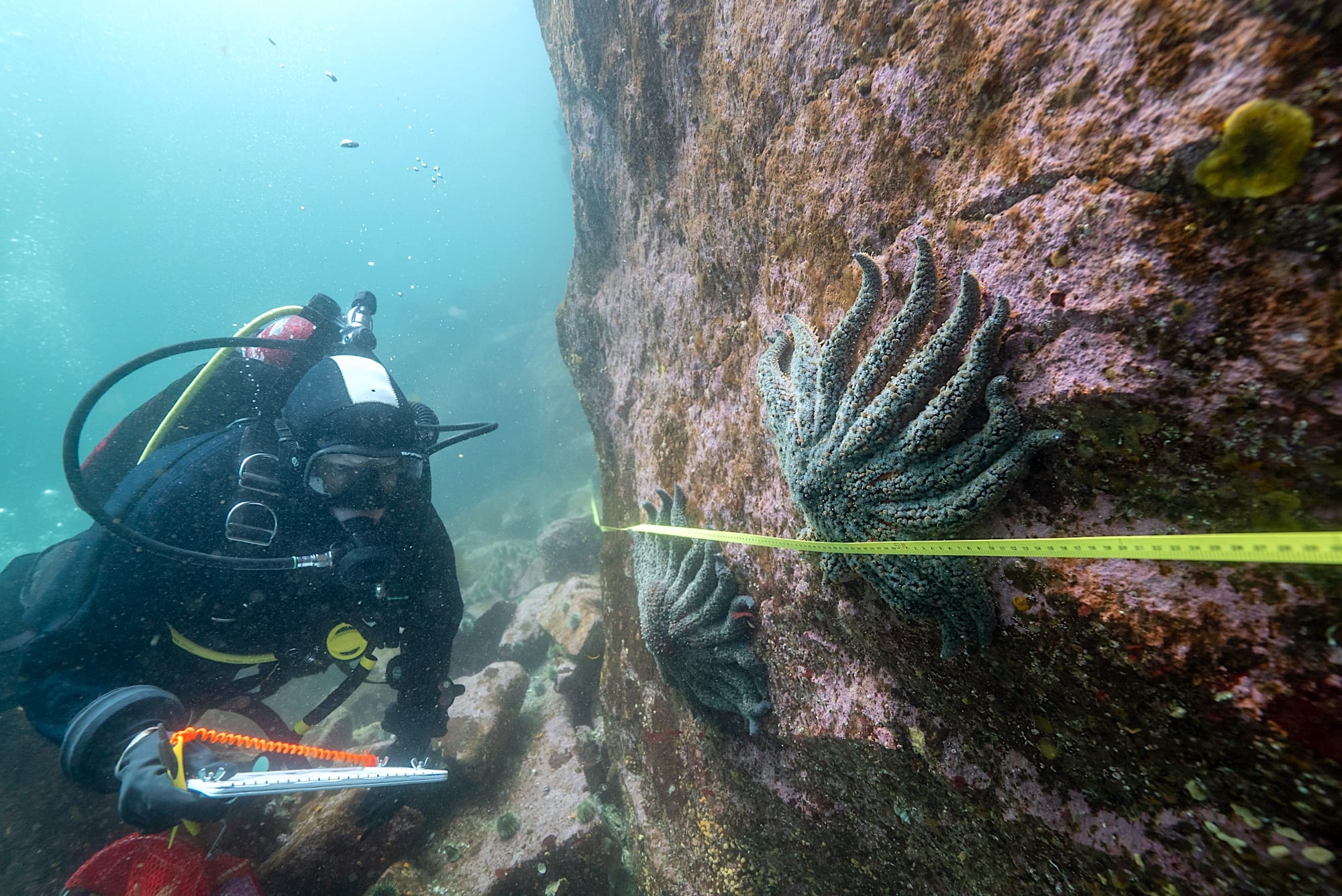
Marine biologist Alyssa Gehman spots a sea star during a dive in coastal British Columbia. (Photo courtesy of Bennett Whitnell/Hakai Institute)
At the end of the 8-kilometre Skookumchuck Trail, about 6 kilometres from Egmont, a lookout leads to one of the strongest tidal rapids in the world. Water rushes through a narrow strait, creating waves and whirlpools. The nutrient-rich rapids provide the perfect home for the purple and orange sea stars, a welcome reward after hiking the moderate-level trail.
Many sea stars call coastal British Columbia home. According to Vancouver Aquarium Biologist Jeff Sha, sea stars show up virtually everywhere there is saltwater in the province. As he says, “They can be seen commonly at low tide, including five minutes from the Vancouver Aquarium in Stanley Park.”
Alyssa Gehman, a marine biologist with the Hakai Institute, fell for sea stars early on. As she says, “My earliest memories date back to a grade eight kayaking trip in Desolation Sound, where I saw brightly coloured sea stars right outside the kayak. There are 20 species common on the coast. But to see most of them, you need to dive.”
But even for those travellers who aren’t ready to squeeze into a wetsuit sea star gazing is accessible. On a six-day tour of the Sunshine Coast, I saw sea stars while hiking, kayaking, and zodiac boating in four prime locations.
Skookumchuck Trail
The gently rolling, 4-kilometre trail to Skookumchuck narrows in Egmont, wends past massive, moss-heavy western hemlock. Light peeks through leaves with varying shades of green. The experience is magical, otherworldly.
At the end of the trail, the Sechelt Rapids reverse direction twice daily, changing the flow of saltwater between the Sechelt and Jervis inlets. The turbulence pulls up plankton and pumps in oxygen from deep waters. Sea stars position themselves in pockets protected from direct flow.
Desolation Sound Marine Park
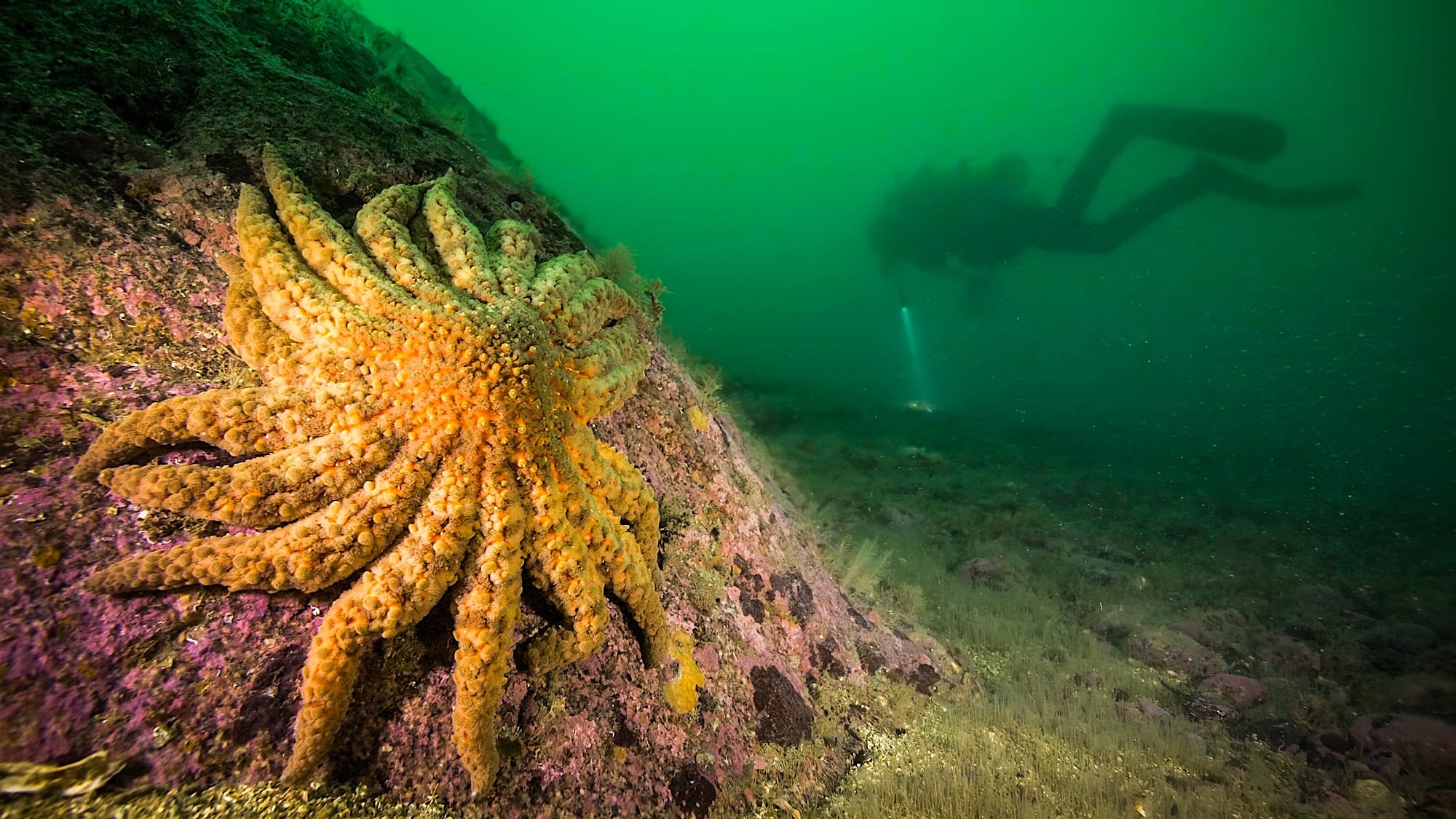
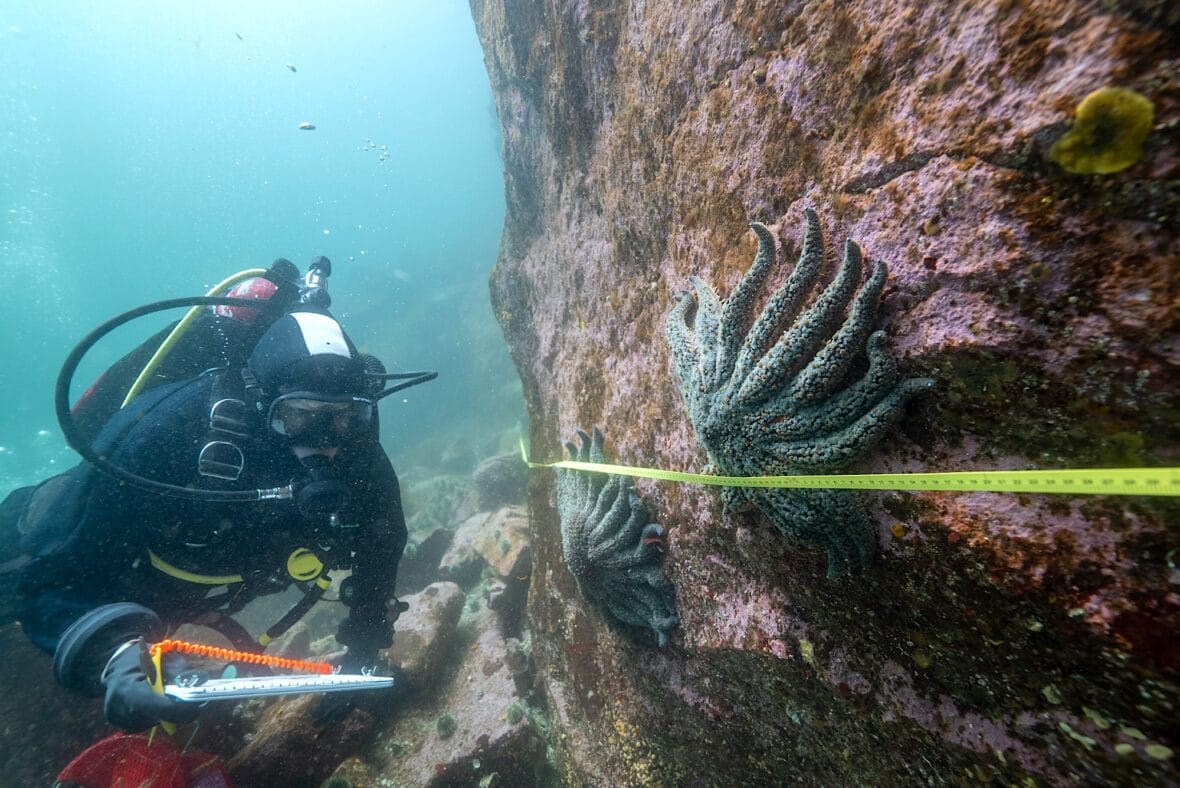
A diver passes a sunflower sea star, which can be found on the rocks, barnacles, and mussels in British Columbia. (Photo courtesy of Grant Callegari/Hakai Institute)
Just north of Lund, Desolation Sound forms one of the most sheltered, warm‑water cruising areas in Canada. Captain George Vancouver sailed into the area in 1792 and described it as “desolate” because it lacked good farmland for growing crops. But the 60 kilometres of stunning shoreline offer solitude and ample sea animal sightings, and are popular with yachters, who stop in one of three glacier-carved bays.
Out on the water with Terracentric Adventures, I saw red-beaked oystercatchers and orange-barked arbutus trees. The snow-peaked Coast Mountains act as a backdrop. Desolation Sound’s deep, cold fjord water supplies oxygen and abundant nutrients. Its granite and metamorphic rock give sea stars hard surfaces on which to attach in sheltered coves.
Halfmoon Bay
While staying at Rockwater Resort, my partner and I paddled into Secret Cove, a maze of tiny islands and channels, 15 minutes north of Sechelt. Here, still water mirrors Douglas firs, leaning over the bedrock shoreline. Except for eagles and the occasional motorboat, it’s absolutely quiet.
We try to pull strokes in unison, but after five minutes, the teamwork breaks down. “Aren’t you steering?” I asked. The truth is, we were both steering, which doesn’t work. We stopped to regroup. We spotted sea stars sticking to exposed rock; the friction melted away.
Armours Beach
Gibsons is the gateway to the Sunshine Coast, just 10 minutes from the Langdale terminal of BC Ferries. It boasts beautiful views of Keats Island across the Shoal Channel, and the North Shore mountains. The tiny town is best known as the filming location of “The Beachcombers”, an iconic Canadian show that ran from 1972 to 1990. Armours Beach is the highest-density sea star zone accessible by foot.
Sea stars attach to rocks and mussel and barnacle beds, and cling to the shaded undersides of boulders. They benefit from gentle tidal flushing, abundant nutrients, and protection from sun exposure. A small pier creates a shaded microhabitat.
They’re easy to find on the Sunshine Coast whether you’re hiking, paddling, or strolling through the surf at low tide. They cluster near their food sources, keeping numbers in check. According to Gehman, travellers can best protect sea stars by keeping a safe distance and logging sightings on apps like iNaturalist, supporting ongoing conservation efforts. Catching a glimpse of these charismatic creatures made my trip.
Knowing more about them added to the awe of the experience. Gehman shared four fun sea star facts that I found fascinating:
Fun Fact 1: Outside Dining
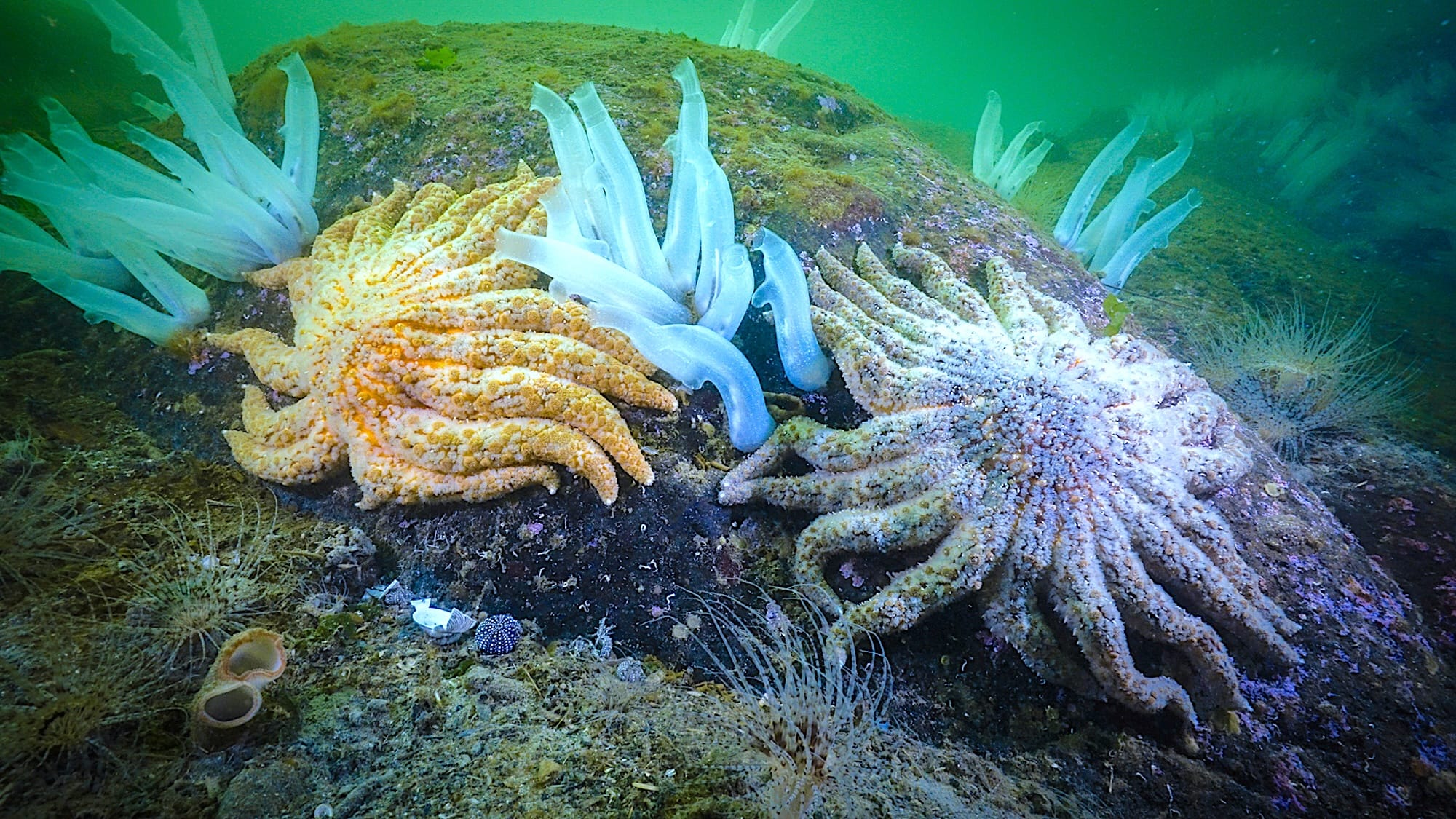
Pycnopodia and vase tunicates are among the sea star species that are abundant in the waters of the Sunshine Coast. (Photo courtesy of Bennett Whitnell/Hakai Institute)
“Sea stars drop their stomachs outside their mouth and dissolve food outside their body,” Gehman says. Digestive enzymes break down the soft tissues externally before the stomach pulls the liquefied lunch back inside.
Fun Fact 2: Armed and Dangerous
Sea stars regenerate arms by sending cells to the injury site to rebuild tissues. Some species have as many as 24 arms.
Fun Fact 3: Mussel Man
“Sea stars look docile, but are pretty major predators,” Gehman notes. They feed on mussels and other organisms to prevent the takeover of coastal habitats. “They eat so many mussels and can change what you see at the beach.”
Fun Fact 4: Stuck On You
Sea stars’ tube feet vacuum-seal to surfaces for moving and feeding. “If they have clamped down, you might need a crowbar. But if you startle them, they’ll use suction but not use glue,” Gehman points out.
While you don’t need a biology degree to appreciate sea stars, these tidbits help you better understand their existence when you encounter them. On the Sunshine Coast, those encounters can be frequent and delightful.