
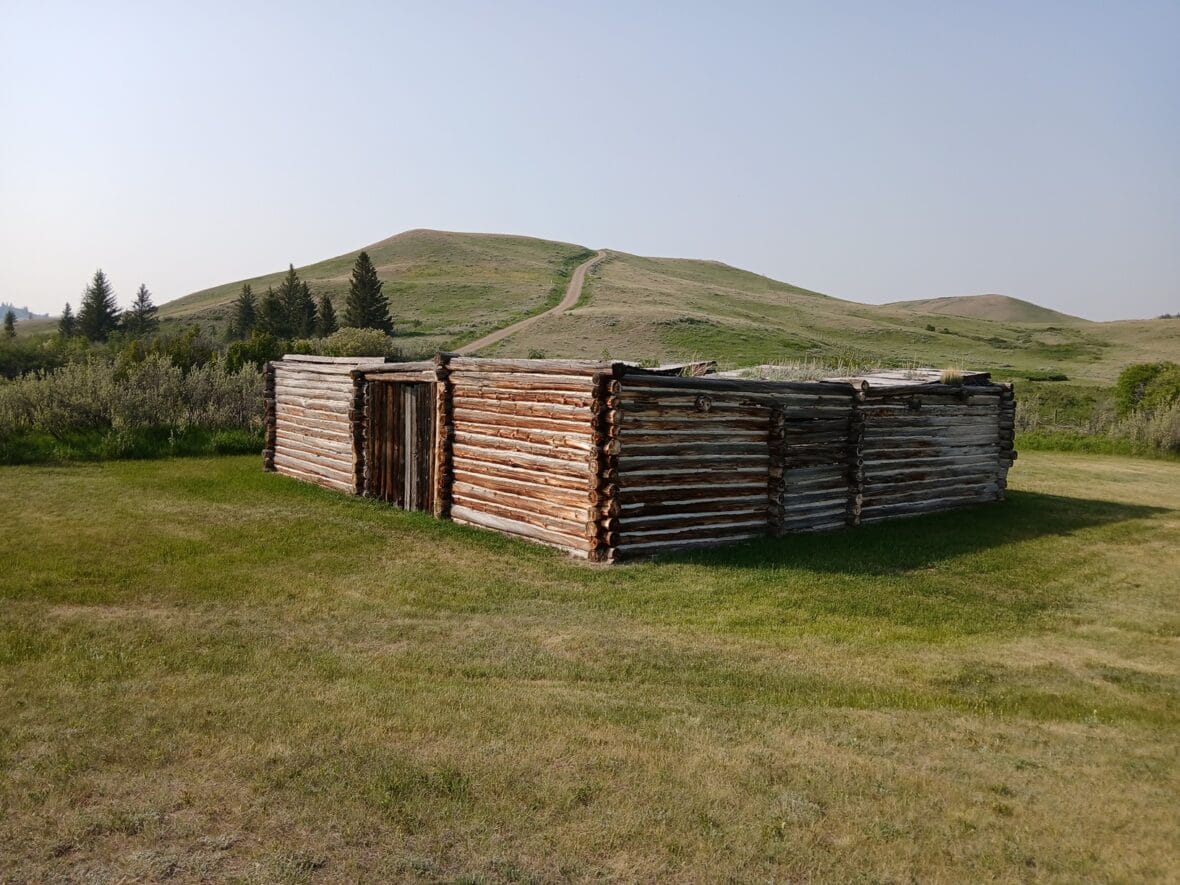


A guide discusses what life was like back in the 19th century at Fort Walsh. The Parks Canada attraction was the first North-West Mounted Police (NWMP) post and headquarters, and was established in what is now Saskatchewan in 1875. (Photo courtesy of Parks Canada)
There’s nothing boring about Canadian history when you walk through the gates of Fort Walsh National Historic Site, in the Cypress Hills of southwest Saskatchewan. A standout destination for a summer or fall road trip, Fort Walsh is an approximately four-and-a-half-hour drive from Calgary, Saskatoon or Regina. It is steeped in history from Canada’s earliest days. Established in 1875, the fort was built close to Saskatchewan’s highest point — 1,392 metres above sea level, and nine metres higher than the Rocky Mountain town of Banff.
“The setting itself is absolutely amazing,” says Fort Walsh interpretation coordinator Omar Murray.
For a short, tumultuous time, Fort Walsh played a prominent and vital role in all of Canada, serving as headquarters for the North West Mounted Police (NWMP) — forerunners of the RCMP — from 1878-82.
Fort Walsh was the first place in what is now Saskatchewan to establish a police fort. Visitors to Fort Walsh — named for North West Mounted Police Inspector James Walsh, who oversaw its construction in 1875 and commanded here until 1880 — can wander through the reconstructed buildings on their own, or take a guided tour for a fee. Tours last about an hour to 90 minutes.

The Cypress Hills Massacre occurred at Fort Walsh on June 1, 1873, near Battle Creek in a region that is today part of Saskatchewan. (Photo courtesy of Parks Canada)
“You get to learn about Canadian history while having fun. You kind of don’t know you’re learning,” Murray says.
The Fort interpreters — all attired in period costume — help bring the 1800s to vivid life, as do all of the objects on display. Each building is filled with items the Mounties used in their daily routines. You can see how they dressed, where they ate their meals, and where they slept. Theirs was a rugged life, of discipline and hard work, enforcing Canadian law and order, and assisting in the implementation of Canada’s contentious and often maligned “Indian Policy.”
Horses and their essential role in helping the Mounties carry out their duties are highlighted in the rebuilt stable, and in a blacksmith shop, where the farrier would have worked.
The fort even had its own jail, with tiny cells, each with a very, very small window.
In the armory, where an armorer would have maintained and repaired the armaments, visitors can get a look at lances, swords, rifles, Snider-Enfield and Winchester carbines, sidearms (revolvers) and artillery — nine- and seven-pound field guns, which are fired on special occasions, as part of the historic site’s weapons program.
“It’s quite a cool experience,” Murray says. “You can feel the concussion on your chest. You can even smell the burnt gunpowder.”
Another immersive experience, which is part of the regular tour, is the trial. It’s quite unexpected as a stern-faced Mountie (Murray, formally dressed in red serge and looking every bit the part) marches up to us and peremptorily takes away four members of our tour group for a “trial” for breaching the law. They sit in the prisoner’s dock, while the rest of us watch with keen interest. The “prisoners” are given scripts to read, playing key roles as defendants in “trials” based on actual legal proceedings that took place at Fort Walsh. Each of the “defendants” does justice to their role; it’s a hoot watching them get into it. Murray says the trial experience is always popular, with school groups and adult tourists alike.

Visitors can learn about the history of Fort Walsh from experienced guides, as well as Indigenous interpreters and Parks Canada archaeologists. (Photo courtesy of Parks Canada)
One trial involved a quarrel between two women. In another, a man was charged with possession of intoxicating liquor — “because it was illegal to have alcohol in the Northwest Territories in the 1870s and 1880s,” Murray explains. “That was one of the catalysts in getting the NWMP out here as soon as they did — to stop the whisky trade. The whisky trade was decimating the Indigenous population.”
First Nations peoples have used the Cypress Hills for thousands of years. As in so many places across Canada, Indigenous relations with the newcomers, the settlers, were complex. As more and more settlers arrived, relations became fraught, with misunderstandings, conflict, and sometimes violence.
In this region, one of the most significant occurrences was the 1873 Cypress Hills Massacre, which took place near Battle Creek, a tributary of the Missouri River. A group of wolfers (wolf hunters) from Fort Benton, Montana — operating under the influence of too much alcohol and the mistaken assumption that a group of Assiniboine (Nakoda) people had stolen their horses — descended on the Nakoda camp of 50 lodges, slaughtering at least 20 men, women and children. No wolfers went to prison; in 1876, three were tried in Winnipeg and acquitted, notes the entry in the Canadian Encyclopedia; and the Canadian government dropped all charges in 1882.
We went by shuttle bus on a special guided tour of the Cypress Hills Massacre site. It is not accessible to private vehicles; however, visitors can access it on foot via the Battle Creek hiking trail, a six-kilometre round trip (approximately two hours). Two abandoned trading posts are nearby. The setting by Battle Creek, so serene and beautiful, is a stark contrast to the darkness, tragedy and injustice of the past.

Fort Walsh and Cypress Hills Massacre National Historic Sites are located along the picturesque Battle Creek valley. (Photo courtesy of Parks Canada)
The Cypress Hills Massacre was a key factor in the establishment of the NWMP. Under the command of Inspector Walsh, the fort played a pivotal role in maintaining peace. After the 1876 Battle of Little Big Horn, in what is now Montana, Lakota Sioux Chief Sitting Bull and approximately 5,000 of his people came to Canada to escape repercussions from the American government.
“We were able to maintain peaceful relations while he was in Canada,” Murray says of Sitting Bull’s 1877-81 period in the country. “It established the NWMP as a force to be reckoned with, and being fair — the esprit de corps that the RCMP still benefit from today.”
In 1877, Sitting Bull met with Inspector Walsh, who promised the chief and his people protection in exchange for peaceful compliance with Canadian law, writes Grant MacEwan in the Canadian Encyclopedia.
Walsh and Sitting Bull understood and respected one another. According to the RCMP Veterans’ Association Vancouver Division, in an online article: “The Canadian government decided that Walsh’s friendship with Sitting Bull was an obstacle to the Sioux’s return to the United States, and in 1880 he was transferred to Fort Qu’Appelle, Saskatchewan. Soon after, he took health leave and returned to Ontario.”
As a tourism destination, Fort Walsh stands out, not only because of its historical significance, but also its setting. “It’s more than just a historic site with old buildings, stories and stuff,” Murray says. “It’s a historic site combined with a natural park, so you have the best of both worlds. It’s an amazing place.”

Professional interpreters and guides will take you back in time. This North-West Mounted Police (NWMP) fort played a key role in establishing Canadian law in the late 1800s. (Photo courtesy of Parks Canada)
One guide explained during our tour that Fort Walsh is a 45-minute drive from the nearest town (Maple Creek), so you know you’ve started an adventure when you decide to come here, adding that the landscape, buildings, and artifacts physically immerse you in the 1870s frontier setting, and the events and stories told by the interpreters help visitors understand and relate to life at that time. In a way it’s like stepping out of a time machine set for the Canadian frontier.
Fort Walsh offers programs for families; the visitor centre features an excellent museum as well as a concession with freshly made meals in July and August. Deep fried bannock with cinnamon and sugar is one of the specialties on offer during peak season, in the summer. The views of the rolling Cypress Hills, seen from the dining area and the adjoining outdoors terrace, are spectacular. It’s utterly peaceful and beautiful, with a feeling of being right where you’re supposed to be, in the moment.

Along with notable historic figures associated with it, Fort Walsh National Historic Site also tells the stories of the Métis and local homesteaders like the Mai family. (Photo courtesy of Parks Canada)
It’s not just history buffs who would enjoy visiting Fort Walsh and the Cypress Hills. The area includes two hiking trails (the easy Métis Trail, which is half a kilometre, and Battle Creek Trail, approximately five kilometres) and plenty of opportunities for photography.
“It scrubs your soul to walk along the creek through the trees,” Murray says. “It kind of centres you back to nature.”
Fort Walsh is open from the Victoria Day long weekend through the end of September — a more relaxed time to visit and especially beautiful with the changing fall colours.
MORE ABOUT FORT WALSH
Website: parks.canada.ca/lhn-nhs/sk/walsh
Getting there: Fort Walsh is approximately 55 kilometres southwest of Maple Creek, Saskatchewan, off Highway 271 near the Cypress Hills Provincial Park West Block. Fort Walsh is open for the season through September 27, 2025.